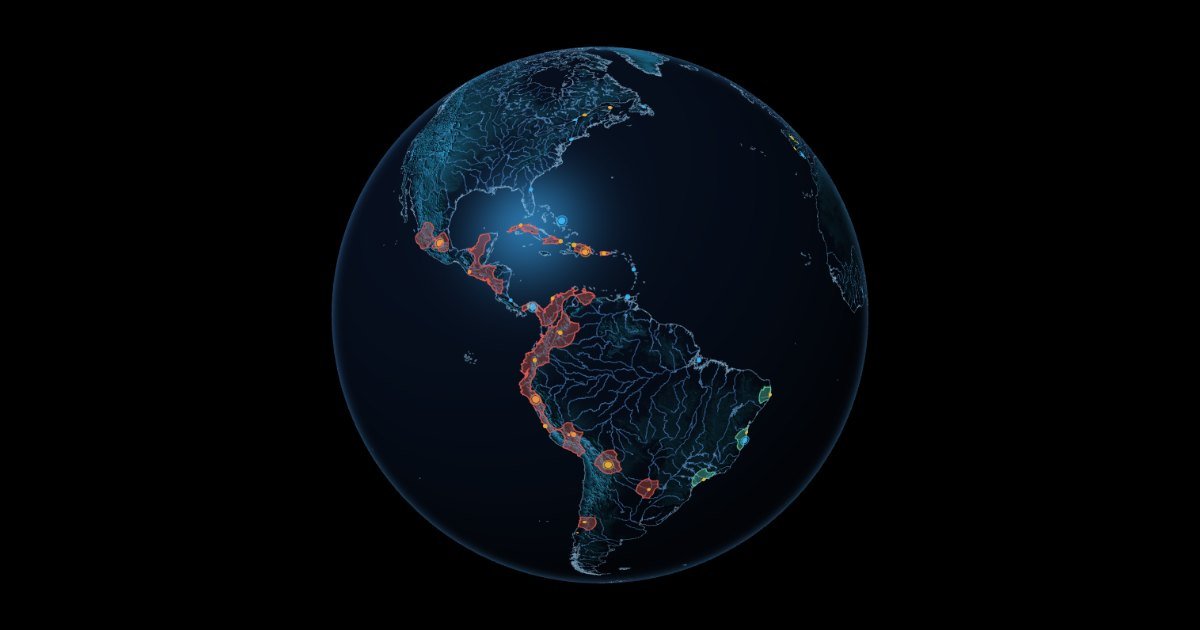
 Play it on the globe →
It was a discovery from one side only: the other side had been there for fifteen thousand years, and by some counts there were more people living in the Americas in 1492 than in Europe. What this map follows is not the crossing but what came after — the coasts reached one at a time, the towns founded on top of other towns, and two European crowns declaring themselves owners of a continent in fifty years. The colour is effective control, not claims: ground turns when somebody stays, not when a sail is sighted, which is why most of the map is still dark when it ends.
How this is made →What is on the map
- 14 Conquests and collapses
- 13 Coasts reached
- 18 Cities founded
- 4 Crowns, treaties and laws
Chronology
- Three ships leave Palos on the morning tide. Nobody aboard knows how wide the ocean is, and the estimate they are sailing on is wrong by halfevent▸
- Three ships touch an island in the Bahamas. The people who meet them on the beach have been there for centuriesevent▸
- The Santa María runs aground on Christmas night; her timbers become La Navidad, the first European settlement in the Americasevent▸
- The second voyage: seventeen ships, twelve hundred men, and the plan is no longer to look but to stayevent▸
- At Tordesillas two kings draw a line down an ocean neither has crossed, and divide what is on the other sideevent▸
- Santo Domingo: the oldest European city still standing in the Americasevent▸
- John Cabot, sailing for England, reaches Newfoundland and thinks it is Asiaevent▸
- Third voyage: Columbus reaches the mainland at Paria and, seeing the fresh water of the Orinoco, writes that this must be a continentevent▸
- Pinzón finds the mouth of the Amazon, fresh water sixty miles out to seaevent▸
- Cabral, bound for India, makes landfall in Brazil — on the Portuguese side of the line drawn six years earlierevent▸
- Fourth and last voyage: Columbus coasts Central America still looking for a strait to Asiaevent▸
- Puerto Rico settledevent▸
- Baracoa, the first town in Cubaevent▸
- Ponce de León sights a coast at Easter and calls it Florida, for the seasonevent▸
- Balboa crosses the isthmus on foot and sees the Pacific: America is not Asia, and there is another ocean beyond itevent▸
- Havana foundedevent▸
- Smallpox reaches Hispaniola. Within two years it will be in Mexico, and it travels faster than the men who brought itevent▸
- Panamá founded on the Pacific shoreevent▸
- Cortés enters Tenochtitlan, a city larger than any in Spain, and is received as a guestevent▸
- La Noche Triste: the Spanish are driven out of the city with heavy losses, and come backevent▸
- Battle of Otumbabattle▸
- Battle of Colhuacatoncobattle▸
- Tenochtitlan falls after a siege of ninety-three days. The largest city in the Americas is razed and Mexico City built on itevent▸
- Verrazzano, sailing for France, enters the Narrows of what will be New York and maps a coast from Carolina to Newfoundlandevent▸
- Alvarado in Guatemalaevent▸
- São Vicente: the first Portuguese town in Brazil, forty years after Cabral saw the coast. Lisbon had been busy with the spice route, and Brazil could waitevent▸
- Cajamarca: a hundred and sixty-eight men take the Inca prisoner in the middle of his own armyevent▸
- Cartagena de Indias, which will become the treasure portevent▸
- Cusco taken: the Inca empire, four thousand kilometres of road and ten million people, has a new masterevent▸
- Brazil is cut into fifteen hereditary captaincies and handed to private men: the Crown will not pay for it, so it sells the riskevent▸
- Ilhéus and Porto Seguro: the captaincies begin to be settledevent▸
- Cartier plants a cross at Gaspé and claims the land for France. He writes down the Iroquoian word for a settlement — kanata — and it becomes the name of a countryevent▸
- Quito founded on the ruins of the Inca cityevent▸
- Lima founded on the coast: the capital moves to where the ships areevent▸
- Olinda, on a hill above the reefs, becomes the capital of the sugar countryevent▸
- Cartier reaches Hochelaga, a town of fifty longhouses on an island in the river, and climbs the hill behind itevent▸
- Battle of Reynogüelénbattle▸
- Battle of Ollantaytambobattle▸
- Recife: the port below Olinda, where the sugar ships loadevent▸
- Battle of Abancaybattle▸
- Asunción foundedevent▸
- Battle of Las Salinasbattle▸
- Bogotá founded on the Muisca plateauevent▸
- Battle of Tocaremabattle▸
- Santiago de Chile founded, and burned to the ground by the Mapuche seven months laterevent▸
- Charlesbourg-Royal: the first French colony in the Americas, on the St Lawrence. Scurvy, a hard winter and Iroquoian hostility close it in two yearsevent▸
- Orellana comes out of the Amazon into the Atlantic, having crossed the continent by river without meaning toevent▸
- The New Laws: the Crown forbids enslaving the Indians and tries to end the encomienda. The colonists rebel, and winevent▸
- Silver at Potosí. Within thirty years it is one of the largest cities on earth, and the mountain is worked by forced labourevent▸
Routes and campaigns
- First voyage: Palos to an island nobody in Europe knew was there
- The return: north to catch the westerlies, and a storm into Lisbon
- Second voyage: seventeen ships, and the plan is to stay
- Cabot, sailing from Bristol for England, reaches Newfoundland and nobody stays
- Third voyage: further south, and the mainland
- Cabral, bound for India, swings west and finds Brazil
- Fourth voyage: still looking for the strait to Asia, along a coast that has none
- Verrazzano maps the Atlantic coast for France, from Carolina to Newfoundland
- Cartier crosses in twenty days, plants a cross at Gaspé and claims a coast for France
- Second voyage: up the great river to Stadacona and Hochelaga, as far as a ship can go
- Orellana goes down the Napo and comes out of the Amazon, having crossed a continent by accident
Background reading: the parent article.
The world in those years
What else was happening while this story unfolded, one year at a time:
1492 · 1494 · 1499 · 1500 · 1509 · 1513 · 1514 · 1516 · 1519 · 1520 · 1521 · 1522 · 1524 · 1526 · 1527 · 1529 · 1532 · 1534 · 1538 · 1542 · 1545