Erask turns Earth into a living atlas. Spin a real 3D globe, drop a base anywhere — a Roman ruin, a volcano, a battlefield — and instantly discover every remarkable place around it. Then press play on a Story and watch history unfold across the map — or write one yourself, on any subject, with the help of your favourite AI.
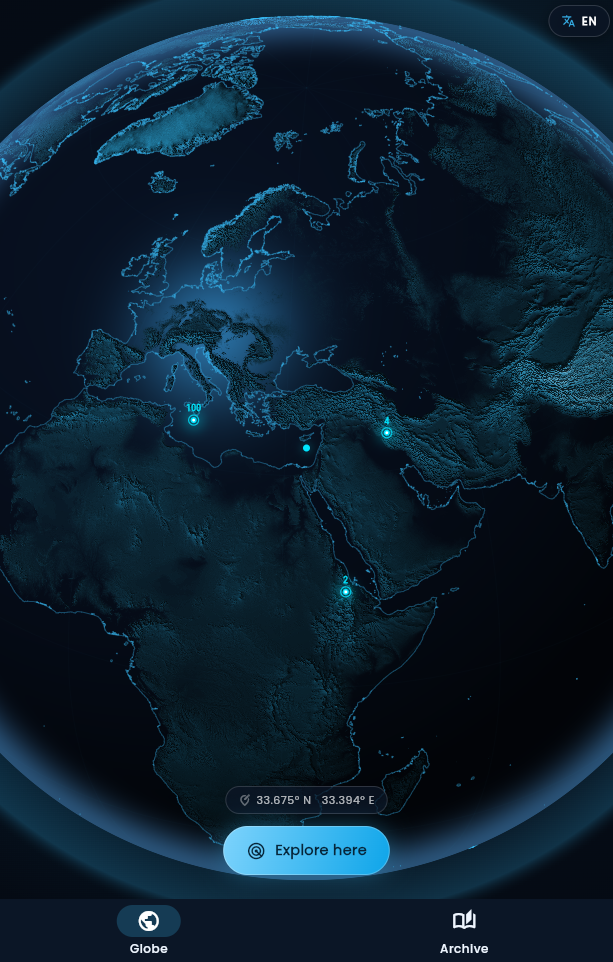
Not a flat map. A hand-crafted 3D globe with GPU-shaded mountain relief from NASA elevation data, precise vector coastlines, thousands of islands and cities that fade in as you fly closer.
Real elevation, shaded in real time on the GPU. The Alps, the Andes and the Himalaya cast their ridges across the sphere.
One tap on “Explore here” scans the area through Wikidata and reveals every notable place around your point — instantly.
Castles, cathedrals, volcanoes, glaciers, beaches, historical battles, sieges and expeditions. If it mattered, it’s on the globe.
Every place opens a gallery from Wikimedia Commons and the full article on Wikipedia, with the photographs and the text that go with it.
Hand-built timelines that play out on the globe, each one researched against its sources — and every event links to the article behind it.
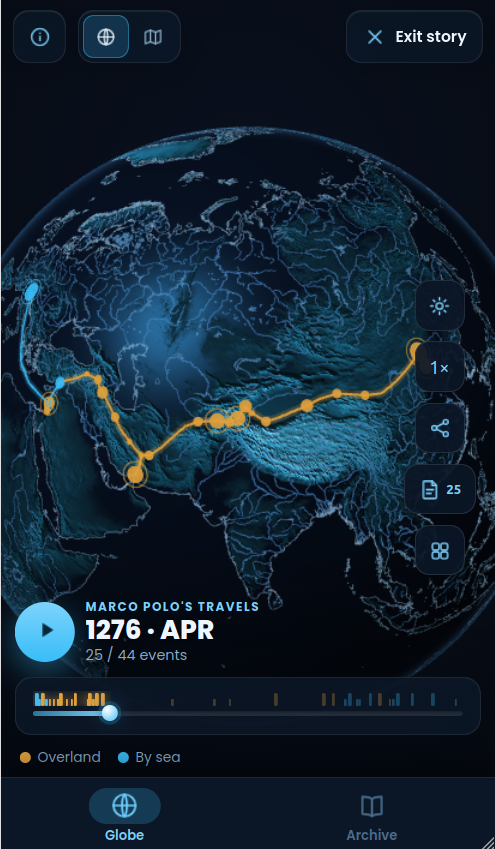
Press play and watch it happen. Armies advance, borders shift, a merchant crosses Asia, a century of detonations lights up the map — every event pinned to the place and the day it happened, with the Wikipedia article one tap away.
Scrub through the years, pause on a turning point, or run it at 1× to 8×. The date on screen is the date on the globe.
Journeys trace their path leg by leg, a moving point at the head of the line — twenty-four years of Marco Polo in under a minute.
Fronts and empires are painted as they were on that day, each faction in its own colour, fading from one snapshot to the next as the war moves.
Battles, sieges, landfalls and tests appear as markers sized by scale. Tap one and Wikipedia opens on that exact moment in history.
How one species took the whole planet, 300,000 BC – AD 1300
1271 – 1299Venice to Xanadu and back, 1271–1295
1860 – 1865One country, torn in two and taken back battle by battle, 1860–1865
See all 18 stories → · 2 more in the making
Our stories are hand-built, one at a time — yours doesn’t have to be. Copy one prompt into ChatGPT, Claude, Gemini or whatever model you use, say what it should be about, and it answers with a link: up to fifty events appearing in place and in order. No account, nothing uploaded — the whole story travels inside the link.
It is a simpler kind of story than the ones above: events appearing on the map, without the shifting territories and the routes that draw themselves. Those are drawn by hand, one snapshot at a time.
The history of coffee, your city, the Space Race, one summer of one war. Your subject is written into the prompt for you — one button and it is on the clipboard.
It chooses the events, looks each one up on Wikidata for its place and its date, and assembles the link — then tells you what it had to leave out.
Nothing is stored on a server: everything is in the address. Send it to someone and you have sent them the story — it plays for them exactly as it played for you.
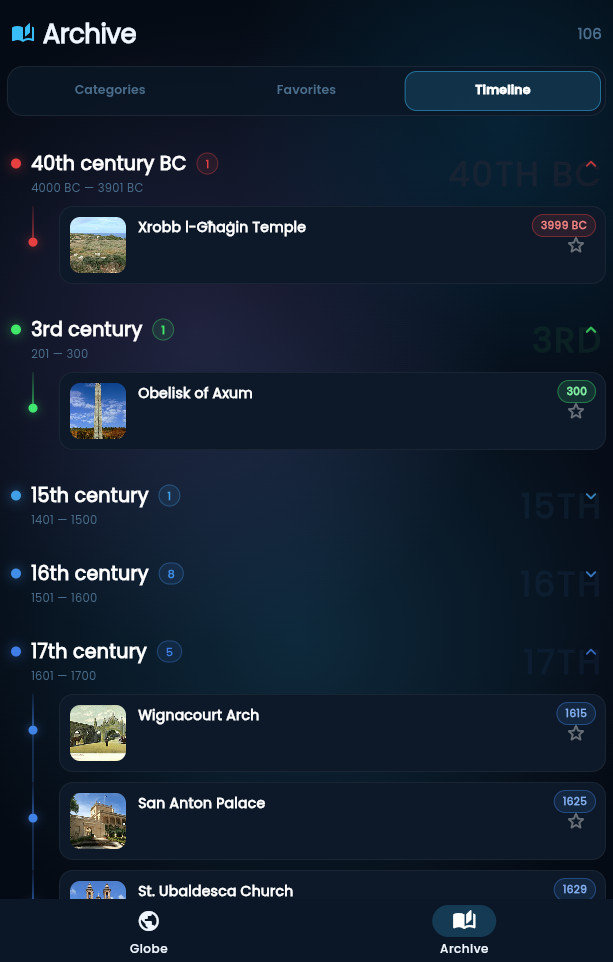
Every place you uncover flows into your personal Archive — no manual filing, ever. Three living views of your journey around the world.
Expandable groups for every kind of place you’ve found. A site that is both a castle and a museum shows up in both — automatically.
Star any article to pin it. Your shortlist survives even if you clear the base it came from.
Your discoveries arranged by century — from the 5th century BC to today — along a glowing timeline, each era with its own color. Foundation dates are fetched from Wikidata automatically.
Any article can point back to its exact spot: one tap and the globe flies you there.
Drag, pinch, dive. From orbit down to a single valley, with mountain relief, coastlines and cities emerging as you approach.
Center any point on Earth and tap Explore here. Erask queries the open knowledge graph and lights up every remarkable place around it.
Browse places grouped by category, open photo galleries, read the stories — and watch your Archive and timeline grow.
Erask is a Progressive Web App — no app store, no download. It runs right in your browser; installing simply adds an icon and lets it open full-screen and work offline.
Every article, photo and date in Erask comes from Wikipedia, Wikidata and Wikimedia Commons — the free knowledge projects built by millions of volunteers. Read the full credits →
No sign-up, no login. Open the app and explore.
No ads, no analytics, no third-party trackers.
Bases, favorites and settings live only on your phone. Privacy policy →
Free, lightweight, and endlessly curious — just like you. No store, no sign-up.
Open Erask